

Digital sales rooms have moved from an emerging idea to a default expectation in B2B selling. Gartner has projected that roughly 30% of B2B sales cycles will run through a digital sales room instead of scattered emails and file links, and the category has grown to match that shift.
Industry estimates put the global digital sales room software market at around 1.2 billion dollars in 2024, with projections putting it as high as 6.5 billion dollars by 2033. That growth has reshaped what buyers expect walking into any enterprise deal in 2026.
What has changed most this year is not whether teams use a digital sales room, but what they expect it to do. A static, branded link with a proposal PDF attached no longer counts as differentiated. Buyers compare vendors on how the deal experience feels, and a room that goes quiet the moment the demo ends now looks dated next to one that keeps working in the background.
The State of the Market in 2026
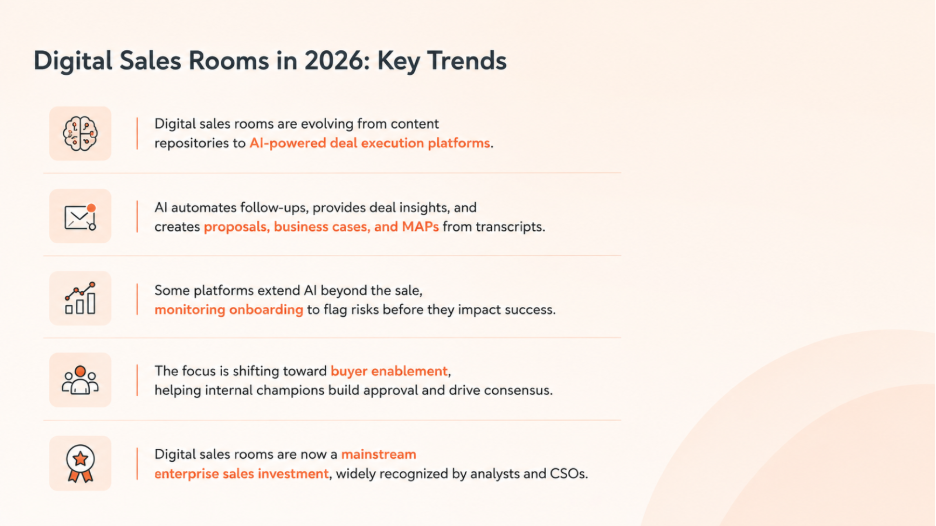
The clearest shift this year is from the digital sales room as a content hub to the digital sales room as an active layer that keeps a deal moving. Most major platforms have added some form of AI in the last twelve months, but they have made meaningfully different bets on what problem that AI should solve.
Some vendors are using AI to flag stalled deals automatically, drafting a re-engagement message that references the last asset a buyer viewed and queuing it for a rep to send.
Others are using AI to generate a full workspace, complete with business case, proposal, and mutual action plan, directly from a call transcript in seconds rather than hours.
A smaller group is extending that AI past the signature itself, using agents that continue watching an account after close to flag onboarding delays before they become churn risk.
A second, related trend is the shift toward buyer enablement rather than pure seller enablement. Reps are no longer the only audience for content inside a room. Buying committees increasingly include an internal champion who has to sell the deal to their own leadership, and platforms are being built to arm that person directly, with content built for internal circulation rather than external persuasion.
Analysts have also started ranking digital sales rooms alongside generative AI as one of the most consequential software investments for chief sales officers, which signals this category has moved well past the early adopter phase and into standard procurement.
Best Practices for Getting Real Value in 2026
Owning a digital sales room license does not automatically shorten a sales cycle. Based on how the strongest-performing teams are using these platforms this year, a few practices consistently separate rooms that get adopted from rooms that get ignored.
- Build around the buyer, not the seller: A room stocked with generic sales collateral gets opened once. A room built around the buyer’s specific questions, pricing, and next steps gets revisited.
- Map the buying committee early: Enterprise deals rarely involve one decision maker. Tagging stakeholders by role in week one, rather than discovering the full committee in week six, is what lets personalization actually work.
- Use a mutual action plan, not just a file library: Shared, dated milestones give both sides a reason to return to the room and make a stalling deal visible before it goes silent.
- Act on engagement data the same day it appears: Seeing that a new economic buyer just opened the pricing page is only useful if a rep follows up quickly, not a week later.
- Keep the room current for the full deal cycle: Outdated pricing or a stale deck erodes trust fast, particularly with technical or procurement stakeholders comparing notes internally.
- Plan for what happens after signature: Whether or not your platform carries the room into onboarding automatically, decide deliberately how deal context gets handed off rather than letting it disappear.
Top Digital Sales Room Software in 2026
1. Projetly
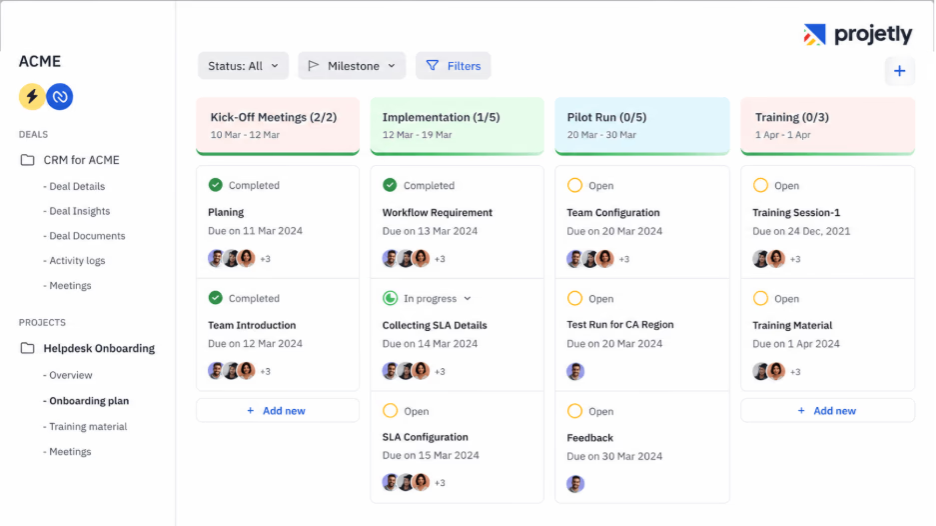
Projetly is an AI native digital sales room built specifically for complex, multi-stakeholder B2B deals. Its defining feature is continuity: the same workspace a rep builds during the sales cycle converts automatically into a live customer onboarding project once the deal closes, carrying over meeting notes, tasks, and the full stakeholder map without a manual rebuild.
AI agents continue monitoring the account after close, flagging onboarding delays or adoption risk before they turn into churn. It is best suited to enterprise teams that want the sales and post-sale motion to run on one shared system of record.
G2 Rating: 4.8 out of 5.
2. Aligned
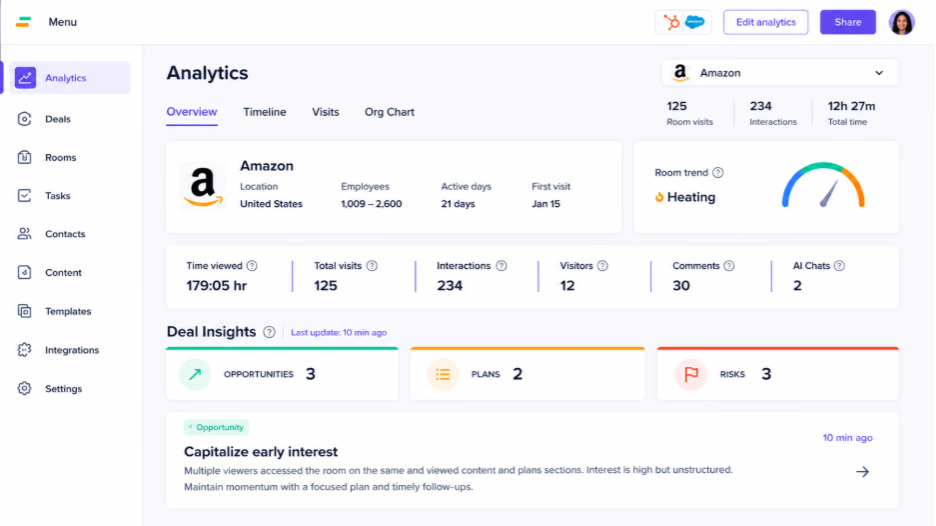
Aligned pairs a digital sales room with a post-sale client portal in a single workspace, letting the room a prospect used during evaluation continue into onboarding and renewal. G2’s Summer 2026 Grid Reports named Aligned the top digital sales room in the small business and mid market segments. Full Salesforce and HubSpot sync is limited to its Enterprise plan.
G2 Rating: 4.6 out of 5.
3. GetAccept
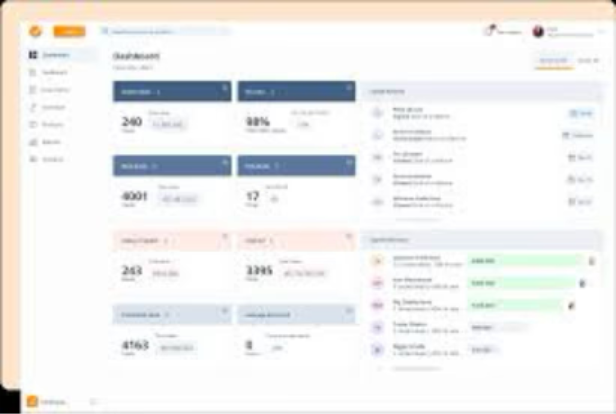
GetAccept bundles a digital sales room with proposal creation, configure price quote tools, and e-signature, positioning itself as a single vendor for the full proposal-to-signature workflow. It is one of the few major DSR vendors offering native Microsoft Dynamics integration in addition to Salesforce and HubSpot.
G2 Rating: 4.6 out of 5.
4. Highspot
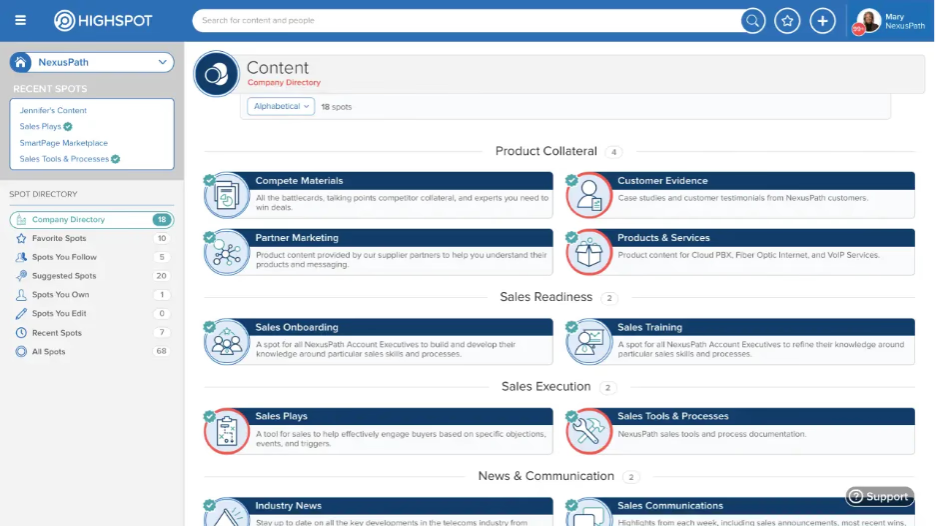
Highspot is primarily a sales enablement platform, with a digital sales room as one feature inside a broader suite built for content management, guided selling, and CRM embedded playbooks. It suits enterprise teams that need internal content governance alongside a buyer facing room.
Highspot and Seismic announced a definitive agreement in February 2026 to combine under the Seismic brand, a deal that had not closed as of this writing.
G2 Rating: 4.7 out of 5.
5. Seismic
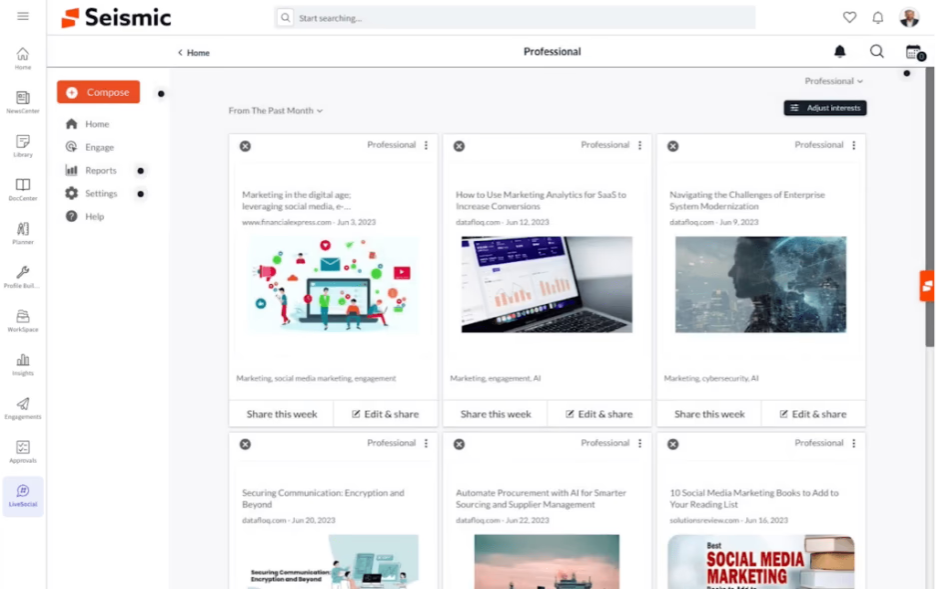
Seismic treats its digital sales room as an extension of a larger content and enablement platform, with LiveDocs for automated document generation and LiveSend for page level buyer engagement tracking, including guest access without a Seismic account. Implementation timelines commonly run several months, and the platform carries a real learning curve for day-to-day users.
G2 Rating: 4.6 out of 5.
Frequently Asked Questions
Is a digital sales room still worth adopting in 2026, given how crowded the category has become?
Yes, but the value depends heavily on execution. Analysts project continued growth in digital sales room adoption, and buyers increasingly expect one. The differentiator in 2026 isn’t whether you have a room, but whether your team acts on the engagement data and keeps the content current.
How is a 2026 digital sales room different from one built two or three years ago?
The biggest shifts are AI agents that actively monitor deals and flag risk rather than just summarizing calls, and a growing number of platforms designed to carry the workspace into onboarding instead of ending at signature.
Should I factor the Highspot-Seismic merger into my evaluation of either platform?
It’s worth building into your decision timeline. The deal was announced in February 2026 and had not closed as of this writing, so pricing, product direction, and support structure could shift once it does.
What’s the single best practice for improving buyer engagement inside a digital sales room?
Personalization has the largest measurable impact. Rooms built around a specific stakeholder’s questions and objections consistently see higher engagement than generic, templated rooms.
Do I need a separate onboarding tool if my digital sales room doesn’t carry over after close?
In most cases, yes. Only a small number of platforms, including Projetly and, more partially, Aligned, are built to convert the sales workspace into a live onboarding project automatically. For everything else, plan for a manual handoff rather than assuming the room will carry forward on its own.
Where the Category Goes from Here
The digital sales room has stopped being a nice-to-have add-on to a CRM and become a core piece of how enterprise B2B deals are run.
The next stretch of the category will likely be defined less by who adds the most AI features and more by who solves the fewest half-finished problems: rooms that stay current without manual upkeep, personalization that goes beyond a buyer’s company name, and workspaces that survive the moment a contract gets signed instead of resetting to zero.
Teams evaluating a platform this year should look past the feature list and ask a simpler question: does this room make the buyer’s job easier, and does it keep working after the deal is won.
That question, more than any single AI capability, is what will separate the platforms that earn a renewal from the ones that get quietly replaced next year.

Janice has been with businesskinda for 5 years, writing copy for client websites, blog posts, EDMs and other mediums to engage readers and encourage action. By collaborating with clients, our SEO manager and the wider businesskinda team, Janice seeks to understand an audience before creating memorable, persuasive copy.